How to Program Hyrox Classes in Your Gym
Adding Hyrox classes means programming a sport with a fixed format, specific equipment and a lot of running. This guide covers what to settle before you start, a simple way to organise a training week, and how to track results. It is general guidance, not a training prescription, so have a qualified coach adapt it to your athletes.
Last reviewed 2026-10-23.
What a Hyrox race looks like
A Hyrox race is eight 1 km runs, each followed by one workout station. The stations always come in the same order: SkiErg, Sled Push, Sled Pull, Burpee Broad Jumps, Rowing, Farmers Carry, Sandbag Lunges and Wall Balls.
Athletes race in one of four divisions: Open, Pro, Doubles and Relay. Loads differ by division, with Pro heavier than Open, and by gender. The organisers publish the current rulebooks and loads on hyrox.com, so check there before you set anything for a class.
The fixed order is useful for a coach. The format is the same at every race worldwide, so you can train the whole race, or any part of it, and know what it is preparing for.
Settle three things before you run a class
Who the class is for, and which loads you will train
Decide whether you are serving newcomers curious about the sport, members preparing for a specific race, or competitive athletes. Then decide which division loads you will train. A class built around Open loads looks different from one built around Pro loads, and a mixed room needs a clear plan for who works to which.
Equipment versus class size
Sleds, SkiErgs and rowers limit how many athletes can work a station at once. Count what you own, then work backwards to a class size you can run without long queues. If you have two sleds and twenty athletes, plan to rotate groups through stations or stagger the starts so nobody queues.
Where the runs happen
The race includes 8 km of running, so the runs need a home. Decide whether they happen outdoors, on a treadmill, or on a loop inside or around your building, and what you will do in bad weather. Make sure the route is safe, and that a coach can see the athletes on it.
A starting outline for a training week
One simple way to organise Hyrox programming is as building blocks that you arrange across the week. Treat this as a starting outline for a qualified coach to adapt to your athletes, not as a training plan. It gives no volumes, paces or loads on purpose.
- Run work. Sessions that build the running the race demands, since the race includes eight 1 km runs.
- Station skill and strength work. Time spent on the movements behind the eight stations, such as technique on the sled or the rower, and the strength that supports them.
- A simulation or partial simulation. A session that strings runs and stations together in race order, either in full or in part, so athletes learn how one effort affects the next.
- Recovery. Planned time to absorb the work, which a coach should build in rather than treat as optional.
How you combine these, and how hard each one is, depends on your athletes, their experience and their goals. Questions about injuries, nutrition or medical conditions belong with qualified professionals, not with a programming template.
Track results so athletes can see where time went
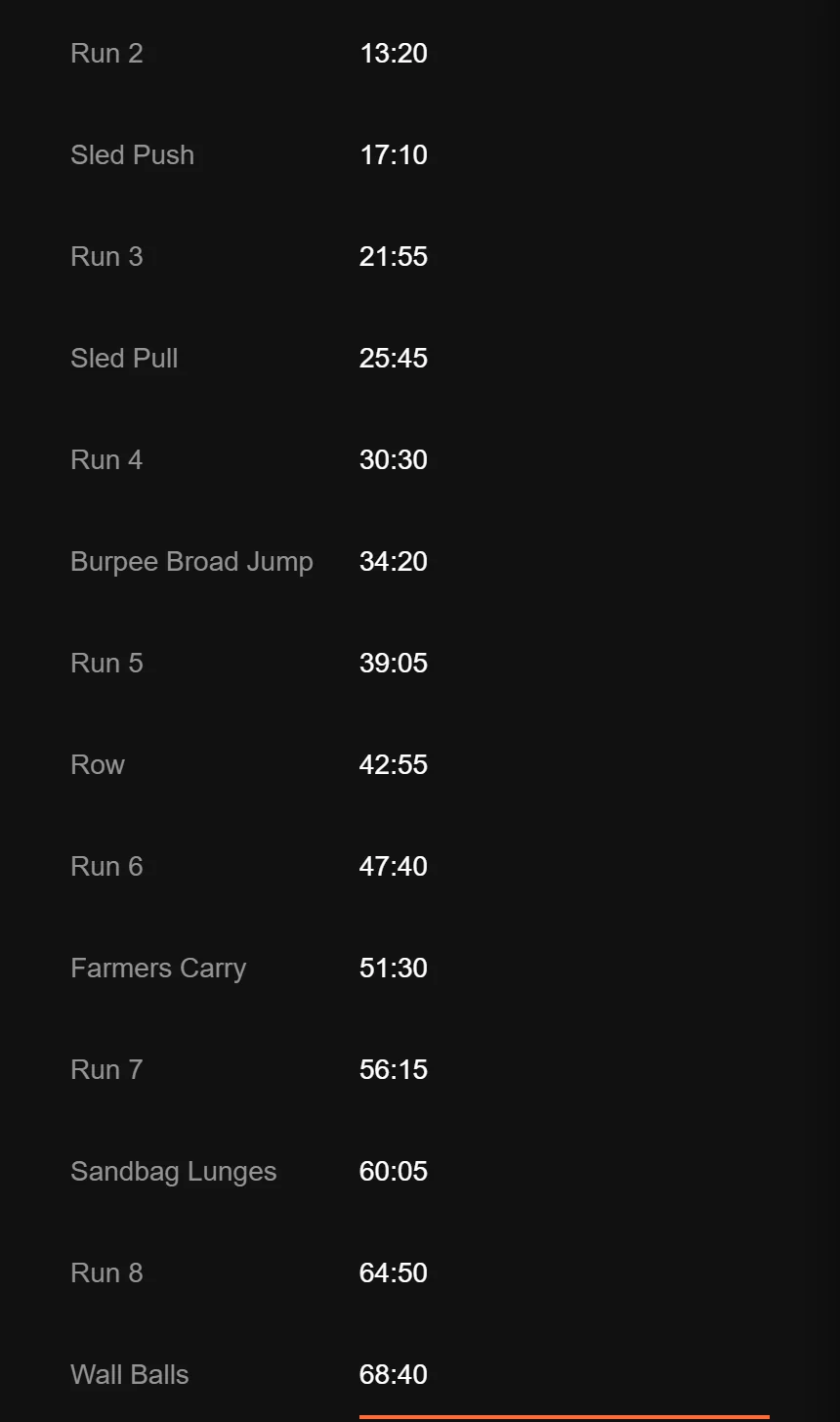
The race rewards balance, so a single finish time hides a lot. Record a split for every run and every station, and athletes can see where their time went, such as a strong run that was followed by a slow sled. Over several simulations, those splits show trends: which station is improving, which one keeps costing time, and whether the runs hold up late in the session.
A shared record also helps coaches. It shows who needs more work on a particular station, and it gives athletes a clear picture of progress that is more useful than a feeling after a hard session.
Run Hyrox beside your other programs
If you already run other programs, such as CrossFit classes or strength cycles, you do not need a separate tool for Hyrox. What matters is that Hyrox has its own programming and its own slot on the schedule, while members, coaches and results stay in one place.
Keep the schedule clear about which session is which, so an athlete never has to guess whether tomorrow is a station day or a run day. If athletes train in more than one program, one login and one record of their results saves them from juggling apps.
Hyrox in Bastion
In Bastion, Hyrox is a track of its own, with a full race-order simulation and shorter formats built from the eight stations, and a split logged for every run and station. Doubles is handled as a pair, each athlete picks a published division and sees that division's loads, and station trends show over time. Each program is its own track on one calendar, with one login for coaches and athletes. See the Hyrox page for details.
Hyrox class programming questions
Do we need every piece of equipment before we start?
No. You can begin with the running and the equipment you already own, and add sleds, SkiErgs and rowers over time. What you own decides how many athletes can work a station at once, so let it shape your class size and how you rotate groups.
Does every class need to be a full race simulation?
That is a coaching decision. A full simulation follows the race order of eight runs and eight stations, while a partial simulation takes a few of them. Your coach should choose what suits your athletes and how recovered they are.
Where do we find current Hyrox rules and loads?
On hyrox.com. Loads differ by division and by gender, and the organisers publish the current rules, so check there before you set loads for a class rather than relying on a guide like this one.
How do we coach athletes at very different fitness levels in one class?
Let each athlete work to the division loads that suit them, and use the same race order for everyone so the session stays shared. A qualified coach can then scale the work to each person.
Can we run Hyrox classes beside CrossFit or strength classes?
Yes. Hyrox can run as one program among several, with its own programming and its own place on the schedule. Keeping every program in one calendar avoids splitting your athletes and your results across tools.
Is Bastion affiliated with HYROX?
No. Bastion is independent software for gyms and is not affiliated with or endorsed by HYROX.
Related pages
See a Hyrox track against your own schedule
Book a short call and we will set up your tracks together, or start the 30-day free trial of Workout OS, no credit card required.
Book a setup call Or start a free trial